Science statistics
Up to 2% of the population has the innate skills of entrepreneurship.
In 98% of the population these skills can be developed.
From 6 to 9 years old are laid behavioural bases of personality (character).
That is why it is so important to start study at the MiniBoss Business School from an early age to develop a habit acquired skills and anchored in the fertile environment of like-minded people.
New Intake to MiniBoss Business School (Harvard for Kids)

July 31, 2022
Why do you need to start in MiniBoss from 6 year?
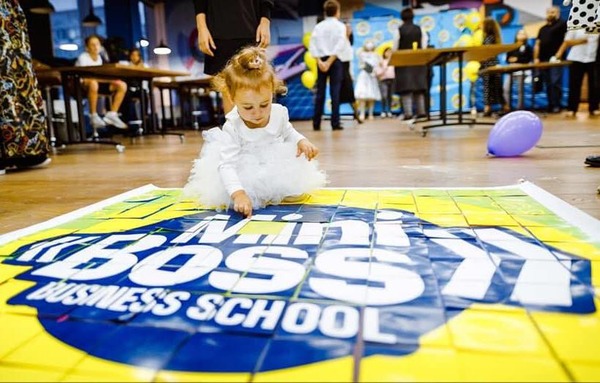
July 30, 2022
Why MiniBoss Business Schools have become so popular in the world?
The MiniBoss Business Schools franchise is actively in demand all over the world. New partners aim to launch schools in their cities and countries. A new business education is needed in today's world!
The secret of popularity MiniBoss in the 5 "pillars":
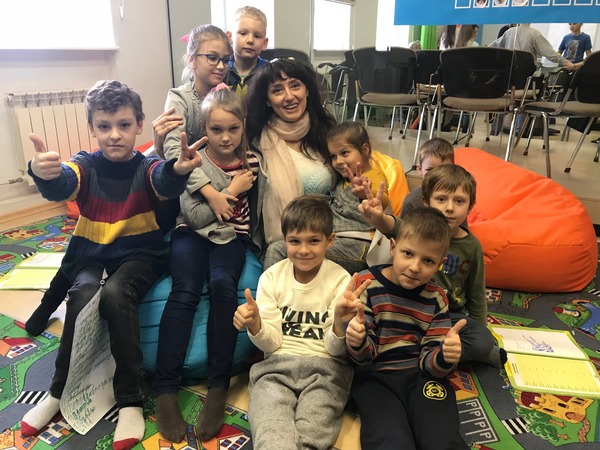
- It's really interesting and fun learning for children! Interactive lessons and games contribute to the rapid and easy assimilation of the material. Business trips, prizes and earned their own money - the best motivation!
- It is an effective training - 99.8% of parents noted progressive changes in their child from the 1st year of school!
- Healthy Environment - Students are required MiniBoss interview, in which they argue that to go to MiniBoss is their own choice. They come here consciously. And motivated to learn in groups of children with good habits - it is a strong instrument for development.
- Preservation of family values – we are for the connection of children with their parents, a deep understanding of the traditional kind, for the creation of family businesses.
- The international leader’s community - Education Network of the MiniBoss Business Schools connects business schools around the world, their students, teachers, supervisors, socially responsible entrepreneurs in the community of socially responsible business with a high mission - to develop a new generation of strong, successful and happy people!
July 29, 2022
Why MiniBoss is the main trend of the 21st century?
We clearly know that today our business schools are necessary for everyone, as in countries with developed economy, and in the countries that just start process of economic development. All countries need a strong new generation of creators-entrepreneurs, new Steve Jobs and Elon Musk!
Social benefits from MiniBoss

The world is changing rapidly!
New management, marketing, IT technology has changed the world significantly over the past 20 years. And the modern school can not be a relevant and useful without a business education.
The entrepreneurs create the world, they raise the world to the fundamentally higher level. And not only their ideas inspire. There are other benefits of entrepreneurship to society.
Entrepreneurs provide the world with:
- creating enterprises,
- providing the jobs,
- create the necessary public goods and services,
- paying taxes.
Entrepreneurs are real leaders - bright and free personality enough to listen to yourself and go for your dreams. These are the people who dared to go their own way and lead others. This call is creativity and self-realization of 100%! And so it is a feeling of happiness and self-sufficiency!
But who in your country teaches children to be successful, confident, enterprising, flexible, persistent, responsible?!
Who teaches kids to be entrepreneurs?
Only one educational institution in the world provides a system and in-depth business education for children and adolescents – it is the International Education Network MiniBoss Business School!
Olga Azarova, MiniBoss Business School, founder.
July 26, 2022
What skills will be in demand in 10 years?
At MiniBoss Business School, students train relevant skills:
- Family values
- Survive in any situation (even crises, pandemics), constantly creating new ideas and businesses, providing your family with material benefits,
- Stress tolerance and generosity, the ability to build healthy, effective communications and create intangible spiritual goods that will allow the world to survive.
22 years ago, they decided to fill a missing niche in the world education system and invented MiniBoss Business School to educate the children of the world:
- Strong and happy family relationships,
- The ability to reveal their talents to 100% and direct them into practice,
- The ability to generate divergent (statistically rare) ideas and create innovations like Henry Ford, Steve Jobs, Elon Musk and others,
- The skill to turn the theory obtained in ordinary schools into practice - successful projects,
- Skill to complete what was started to the end and achieve results, and not to drop everything in the middle of the way,
- The skill to create great teams and manage them!
- Present and negotiate skills!
Olga Azarova, MiniBoss Business School, founder.
July 25, 2022
20 Things Elon Musk Thinks Should Be Taught to All at a Young Age
Elon Musk reposted an infographic which was titled ‘50 Cognitive biases to be aware of so you can be the best version of yourself’. He captioned the post "should be taught to all at a young age".
Cognitive biases are shortcuts your mind uses when you need to make a decision quickly. They can cause you to act against your best interests or the most logical option.
1. Fundamental Attribution Error: We judge others on their personality or fundamental character, but we judge ourselves on the situation.
2. Self-Serving Bias: Our failures are situational, but our successes are our responsibility.
3. In-Group Favoritism: We favor people who are in our in-group as opposed to an out-group.
4. Bandwagon Effect: Ideas, fads and beliefs grow as more people adopt them.
5. Groupthink: Due to a desire for conformity and harmony in the group, we make irrational decisions, often to minimize conflict.
6. Halo Effect: If you see a person as having a positive trait, that positive impression will spill over into their other traits. (This also works for negative traits).
7. Moral Luck: Better moral standing happens due to a positive outcome; worse moral standing happens due to a negative outcome.
8. False Consensus: We believe more people agree with us than is actually the case.
9. Curse of Knowledge: Once we know something, we assume everyone else knows it, too.
10. Spotlight Effect: We overestimate how much people are paying attention to our behavior and appearance.
11. Availability Heuristic: We rely on immediate examples that come to mind while making judgments.
12. Defensive Attribution: As a witness who secretly fears being vulnerable to a serious mishap, we will blame the victim less and the attacker more if we relate to the victim.
13. Just-World Hypothesis: We tend to believe the world is just; therefore, we assume acts of injustice are deserved.
14. Naïve Realism: We believe that we observe objective reality and that others are irrational, uninformed, or biased.
15. Naïve Cynicism: We believe that we observe objective reality and that other people have a higher egocentric bias than they actually do in their intentions/actions.
16. Forer Effect (aka Barnum Effect): We easily attribute our personalities to vague statements, even if they can apply to a wide range of people.
17. Dunning-Kruger Effect: The less you know, the more confident you are. The more you know, the less confident you are.
18. Anchoring: We rely heavily on the first information introduced when making decisions.
19. Automation Bias: We rely on automated systems, sometimes trusting too much in the automated correction of the actually correct decisions.
20. Google effect (aka Digital Amnesia): We tend to forget information that's easily looked up in search engines.
See full infographic
July 24, 2022
15 Things Every Aspiring Entrepreneur Should Know

What every entrepreneur should know before they start their first business. Tips from an entrepreneur Mark Mason.
1. Monetize your free time. Take some of the time you use for socialising and use it to build your business.
2. Surround yourself with other entrepreneurs. Surround yourself with the type of people you want to become. Make sure your friends are not those who want to sit and do nothing about their lives. Find other people who are in a similar position as you and push and motivate one another.
3. Business ideas don’t matter, what matters is execution. A lot of people are proud of themselves for coming up with a cool idea. But the most successful businesses in history were rarely new ideas. Google wasn’t a new idea. Facebook wasn’t a new idea. Microsoft wasn’t a new idea. All of these companies merely executed better than anyone else.
4. Obsess about your brand. The reality of the current economy is that pretty much any information, product or service a person wants, they already have dozens of choices of who to purchase them from. Scarcity doesn’t exist anymore. Differentiation purely through price or quality is an almost impossible strategy for entering or dominating a new market. What dominates now is brand. Your brand defines the relationship you have with your prospect and customer.
5. Believe in what you’re doing. Otherwise, even if you do become successful, you’re just stuck in another grind. But this time, it’s of your own making.
6. Business is not about making money. It’s about value and values. If you continue to monetize what you personally value, you’ll never tire of working (in fact, you’ll look forward to it). If you optimize the value your business generates, the money will happen as a side-effect. There’s a subtle difference between value and money. Sometimes you must eat a chunk of money to create greater long-term value. If you’re just in it for the bottom line, you’ll never be willing to do this.
7. The 1000 Day Rule. The 1000 day rule states that you should expect to be WORSE off than you were at your day job for the first 1000 days of your new business.
8. Treat your customers like family. They’re the only reason you’re here in the first place. Treat them with respect. Reply to their emails promptly. Answer their questions.
9. Don’t deliver a product, deliver an experience. Steve Jobs said that he wanted Apple products to provide an experience, not just a function. Apple is possibly the strongest brand on the planet right now. This is what I mean when I say obsess about your brand: obsess about the experience you’re giving your customers, not just the information or product you’re giving them.
10. This will be a part of your permanent identity, choose wisely. The idea of, "I’ll do this for a few years, make a bunch of money for a few years, and then go do what I REALLY love!" is a myth. It never works out.
A source
July 23, 2022
The Only Real Strategy If You Want To Be A Successful Entrepreneur

In fact, creating more work is one of the most effective marketing techniques of all. Bestselling of the 48 Laws of Power Robert Greene saw his sales really begin to grow after his third book.
The point is: Making stuff that stands the test of time will take time. But you don’t just sit there and wait. That’s now how work becomes a perennial seller. You have to build to that. You have to keep going.The idea that good work compounds itself is not just anecdotal. A study done by economists Alan Sorensen and Ken Hendricks explore this phenomenon in music. It turns out that with each new album, the sales of a band’s previous albums will increase. As the researchers wrote, "Various patterns in the data suggest the source of the spillover is information: a new release causes some uninformed consumers to discover the artist and purchase the artist’s past albums." In fact, sales of non-debut albums increase by an average of 25 percent because of this additional discovery and exposure.
Nor does this phenomenon necessarily limit itself to art. Apple didn’t market the iPod or iPhone and then stop. It has made new and improved versions of those products almost on a yearly basis for more than a decade now.
This was an explicit part of Steve Jobs’s business strategy as well as his personal strategy. As he said, "If you do something and it turns out pretty good, then you should go do something else wonderful, not dwell on it for too long. Just figure out what’s next."
Think about Woody Allen - he does a movie nearly every year, and has for decades. He explained that he goes for "quantity" as a way to get to quality. "If you make a lot of films," he said, "occasionally a great one comes out. Films never come out in the end how you expect them to at the start."
Obviously there are exceptions to this - there are plenty of brilliant creators who have made only one thing. They are still entrepreneurs just as Harper Lee is clearly an author.
But wouldn’t the world be a better place if Ralph Ellison had written another book?
Hopefully Mark Zuckerberg will start another company someday. Why should anyone’s first product or project be the end of it?
It’s not enough to make one great work. You should try to make a lot of it. Very few of us can afford to abandon our gift after our first attempt, convinced that our legacy is secured.
Nor should we.
We should prove to the world and to ourselves that we can do it again… and again.
July 22, 2022
Mentally Strong People: The 8 Things They Avoid

1. Waste Time Feeling Sorry for Themselves. You don’t see mentally strong people feeling sorry for their circumstances or dwelling on the way they’ve been mistreated. They have learned to take responsibility for their actions and outcomes, and they have an inherent understanding of the fact that frequently life is not fair. They are able to emerge from trying circumstances with self-awareness and gratitude for the lessons learned. When a situation turns out badly, they respond with phrases such as "Oh, well." Or perhaps simply, "Next!"
3. Shy Away from Change. Mentally strong people embrace change and they welcome challenge. Their biggest "fear," if they have one, is not of the unknown, but of becoming complacent and stagnant. An environment of change and even uncertainty can energize a mentally strong person and bring out their best.
4. Fear Taking Calculated Risks. A mentally strong person is willing to take calculated risks. This is a different thing entirely than jumping headlong into foolish risks. But with mental strength, an individual can weigh the risks and benefits thoroughly, and will fully assess the potential downsides and even the worst-case scenarios before they take action.
5. Make the Same Mistakes Over and Over. We all know the definition of insanity, right? It’s when we take the same actions again and again while hoping for a different and better outcome than we’ve gotten before. A mentally strong person accepts full responsibility for past behavior and is willing to learn from mistakes. Research shows that the ability to be self-reflective in an accurate and productive way is one of the greatest strengths of spectacularly successful executives and entrepreneurs.
6. Give Up After Failure. Every failure is a chance to improve. Even the greatest entrepreneurs are willing to admit that their early efforts invariably brought many failures. Mentally strong people are willing to fail again and again, if necessary, as long as the learning experience from every "failure" can bring them closer to their ultimate goals.
7. Feel the World Owes Them Anything. Particularly in the current economy, executives and employees at every level are gaining the realization that the world does not owe them a salary, a benefits package and a comfortable life, regardless of their preparation and schooling. Mentally strong people enter the world prepared to work and succeed on their merits, at every stage of the game.
8. Expect Immediate Results. Whether it’s a workout plan, a nutritional regimen, or starting a business, mentally strong people are "in it for the long haul". They know better than to expect immediate results. They apply their energy and time in measured doses and they celebrate each milestone and increment of success on the way. They have "staying power." And they understand that genuine changes take time. Do you have mental strength? Are there elements on this list you need more of? With thanks to Amy Morin, I would like to reinforce my own abilities further in each of these areas today. How about you?
How Adults Can Encourage Kids To Be Original Thinkers

The book - written by Adam Grant, a professor at the Wharton School of the University of Pennsylvania - is not just a guide for adults.
Its pages are littered with interesting advice on how teachers and parents can encourage and cultivate their kids to be original, too.
Grant writes about the importance of getting kids to take risks, to embrace their own curiosity and to be confident in where their minds wander.
How can parents facilitate risk-taking with their kids?
One of the biggest mistakes that a lot of parents make is they spend all their time enforcing rules, and I'm guilty of this. Every time one of my daughters misbehaves, I'm like, "New rule!" And then I don't end up doing a whole lot with it.
But the sad thing about rules is that they don't teach kids to think for themselves. And kids try to figure out how they can either avoid taking risks altogether, or to take risks that they can get away with. As opposed to learning to take sensible risks that will allow them to try new things.
And kids then end up defining the values for themselves, and are much more likely to go against the grain and take risks that allow them to live by these values but don't necessarily match up with conventions or social norms. And the upshot of that is, they're much more likely to become original.
So what about having kids do chores?
No, of course you should have your kids do chores. So what you see is that enforcing a bunch of rules is not a problem as long as you explain why they matter. So it's not about saying there are rewards and punishments. It's about saying, "Here are the rules we have. And this is what they mean to us. This is how they really connect with our core values."
That kind of sounds like talking to kids like adults? Kind of explaining the background of things?
It's very much about raising kids to have responsibility. So, you know, when your kids are going to do chores, you say, "Look. This is why it's important to us to have a neat and clean house." Or, "This is why we care about respecting our things." And then you give your kids some responsibility and guess what? They actually love it.
It's the idea that they can be in charge of things. That they can be helpers. That they have something to contribute. If you frame it right, you're doing them a favor, right? As opposed to, sort of, constraining their freedom.
Are there ways that schools or school leaders can incorporate some of the things in your book to create a culture around originality?
So the first thing is that there's some really cool evidence showing that kids are much more likely to think in original ways if you teach them in conditionals rather than in absolutes.
So instead of saying, you know, "This is a book," you teach them, "This could be a book." And then they're more likely to ask questions about the things that they say as opposed to assuming that there's one right answer. We could do a lot more conditional teaching. I think we could do a lot more encouraging kids to ask questions about multiple possibilities as opposed to searching for the one correct answer.
July 04, 2022
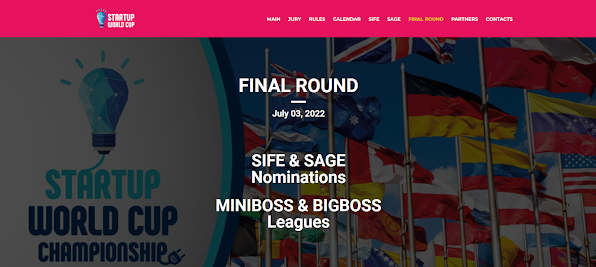
2022 Startup World Cup Championship (SWCC) defined champions!
2022 Startup World Cup Championship (SWCC) defined champions!
We are already holding the 22nd Startup World Championship among children and youth. Today at the 2022 World Cup there are 22 countries, 22 jury members, 22 participants in the final of each league.
We are pleased to announce the WINNERS of the 2022 Startup World Cup Championship (2022 SWCC).
More than 100 teams from 22 countries of the world took part in the SWCC 2022.
We congratulate the nominees and winners as well as all the participants who presented their achievements to the main global stage.
The Startup World Cup Championship is held annually as part of a one-year training cycle for students of the International Educational Network MINIBOSS & BIGBOSS BUSINESS SCHOOLS, which now has more than 60 branches around the world.
Every MINIBOSS BUSINESS SCHOOL student (6-17 years old) and every BIGBOSS BUSINESS SCHOOL student (15+ years old) received an investment in local Startup Forum to realize their idea. The most successful and most innovative projects were determined at the national championship.
The respected jury, consisting of socially responsible entrepreneurs, marked with their assessments those projects that meet the criteria:
- innovation,
- financial result,
- benefit to society,
- social responsibility,
- teamwork,
- marketing strategy,
- cooperation,
- work with clients,
- presentation and ability to answer questions,
- the depth of involvement of the team and their partners in the presented project,
- survival during crises, etc.
Congratulations to all participants!
This is a new round in development and a new step towards an independent life, towards a conscious choice of one's own path, towards one's success, towards economic security and financial well-being of the family, in other words - towards a HAPPY FUTURE!!!
The winners are here:
July 02, 2022
3 Ways to Learn Anything Faster and Better
1. Be adventurous
According to a researcher, learning becomes more effective (rather than it being passive) by exploring different locations. It is also connected to the fact that learning does not solely happen within the four corners of a room. Sometimes you have to exert an effort to explore different work places to see how it can benefit you in terms of retention and absorption of information.
Science explains that different environmental cues can be associated to a certain material or skill that you’re trying to learn which makes it easier to recall later on.
2. Don’t "overlearn"
People may feel that the longer you practice a certain skill, the more you’ll be good at it. Oftentimes, it leads to what we call "overlearning". Science belies this as it discovered that taking regular breaks will enhance one’s overall productivity as well as focus.
Another study reveals how "distributed practice" or breaking up learning into short sessions could be more beneficial as compared to exhausting so much time and effort.

July 01, 2022
CHOOSE COUNTRY, CITY & BRANCH MINIBOSS
MINIBOSS BUSINESS SCHOOL
AUSTRALIA

MINIBOSS BUSINESS SCHOOL
ARMENIA

MINIBOSS BUSINESS SCHOOL
AZERBAIJAN


MINIBOSS BUSINESS SCHOOL
CZECH REPABLIC


MINIBOSS BUSINESS SCHOOL
IRELAND

MINIBOSS BUSINESS SCHOOL
KAZAKHSTAN


MINIBOSS BUSINESS SCHOOL
POLAND

MINIBOSS BUSINESS SCHOOL
SCOTLAND

MINIBOSS BUSINESS SCHOOL
SOUTH AFRICA


.png)


MAIN OFFICE
UNITED KINGDOM
.jpg)
BRANCHES
WARSZAWA (POLAND)
warszawa.miniboss-school.com
.png)
VINNITSIA (UKRAINE)
vinnitsia.miniboss-school.com
.png)
VILNIUS (LITHUANIA)
vilnius.miniboss-school.com
.png)
VARNA (BULGARIA)
.png)
TBILISI (GEORGIA)
.png)
TASHKENT (UZBEKISTAN)
.png)
SOFIA (BULGARIA)
.png)
RIGA (LATVIA)
.png)
PRAGUE VACLAVAK (CZECH REPUBLIC)
.png)
PRAGUE 1 (CZECH REPUBLIC)
.png)
ODESA (UKRAINE)
.png)
NUR-SULTAN (KAZAKHSTAN)
.png)
MANILA (PHILIPPINES)
.png)
LVIV (UKRAINE)
.png)
KYIV (UKRAINE)
.png)
KLAIPEDA (LITHUANIA)
.png)
KHERSON (UKRAINE)
.png)
KAUNAS (LITHUANIA)
.png)
JOHANNESBURG (SOUTH AFRICA)
.png)
JAKARTA (INDONESIA)
.png)
IVANO-FRANKIVSK (UKRAINE)
.png)
GLASGOW (SCOTLAND)
.png)
EDINBURGH (SCOTLAND)
.png)
DUSSELDORF (GERMANY)
.png)
DUBLIN (IRELEND)
.png)
DUBAI (UAE)
.png)
DNIPRO (UKRAINE)
.png)
CHISINAU (MOLDOVA)
.png)
CHERNIVTSI (UKRAINE)
.png)
BURGAS (BULGARIA)
.png)
BRISBANE (AUSTRALIA)
.png)
BISHKEK (KYRGYZSTAN)
.png)
BATUMI (GEORGIA)
.png)
BANGKOK (THAILAND)
.png)
BAKU (AZERBAIJAN)
.png)
BADEN-BADEN (GERMANY)
.png)
ATYRAU (KAZAKHSTAN)
.png)
ANTALYA (TURKEY)
.png)
ALMATY (KAZAKHSTAN)
.png)
Subscribe to:
Comments (Atom)
MINIBOSS & BIGBOSS FAMILY BUSINESS CAMPS 2025

MALDIVES, July 07-15, 2025
GLOBAL BUSINESS WEEK 2026

July 07-15, 2026 Davos, Switzerland
EdTech 2026 - The Global Education, Innovation and Startuping Forum & Expo

July 07-15, 2026 Davos, Switzerland
COACH PROGRAM FOR PARENTS

COURSE PROFORIENTATION
